12-week upper/lower hypertrophy program for experienced lifters
· #fitness #training #hypertrophy
Who it is for: adults with several years of lifting experience who want to add muscle while keeping fat gain small.
Format: 4 lifting days and 2 easy cardio sessions per week, 12 weeks, about 83 hard sets per week.
RIR = reps in reserve (1 RIR means you stop with one clean rep left). “A1/A2” means alternate the two exercises to save time. That is a practical choice, not an evidence-based requirement.
1. Before you start: pick loads by effort, not by max
Do not test one-rep maxes to set up this program. Choose starting loads by effort instead.
- In weeks 1-2, pick a load you could lift for the target reps with 2-3 reps in reserve. Start on the light side.
- Rule for load: if you finish a set and feel you could have done 4 or more extra reps, the load is too light. Add 5-10% on the next set or session.
- Adjust until the prescribed RIR feels right, usually by about week 3.
- If you are returning after a layoff, expect loads to climb quickly in the first weeks. That is normal, so keep the early jumps modest.
Warm-up (all days): 5 min easy cardio, then 2-4 progressively heavier ramp-up sets before the first compound lift. Warm-up sets do not count as working sets.
2. The program
Weekly layout
| Day | Session |
|---|---|
| Fri | Upper A |
| Sat | Lower A |
| Sun | Zone 2 cardio 30-40 min + 10 min shoulder and thoracic mobility |
| Mon | Upper B |
| Tue | Lower B |
| Wed | Optional Zone 2 cardio 30-40 min |
| Thu | Rest |
Zone 2 means easy enough to speak in full sentences (a practical talk test). Use cycling, incline walking or rowing. Avoid hard conditioning and intervals during this block so recovery goes into lifting.
Upper A (Friday): horizontal pressing and pulling
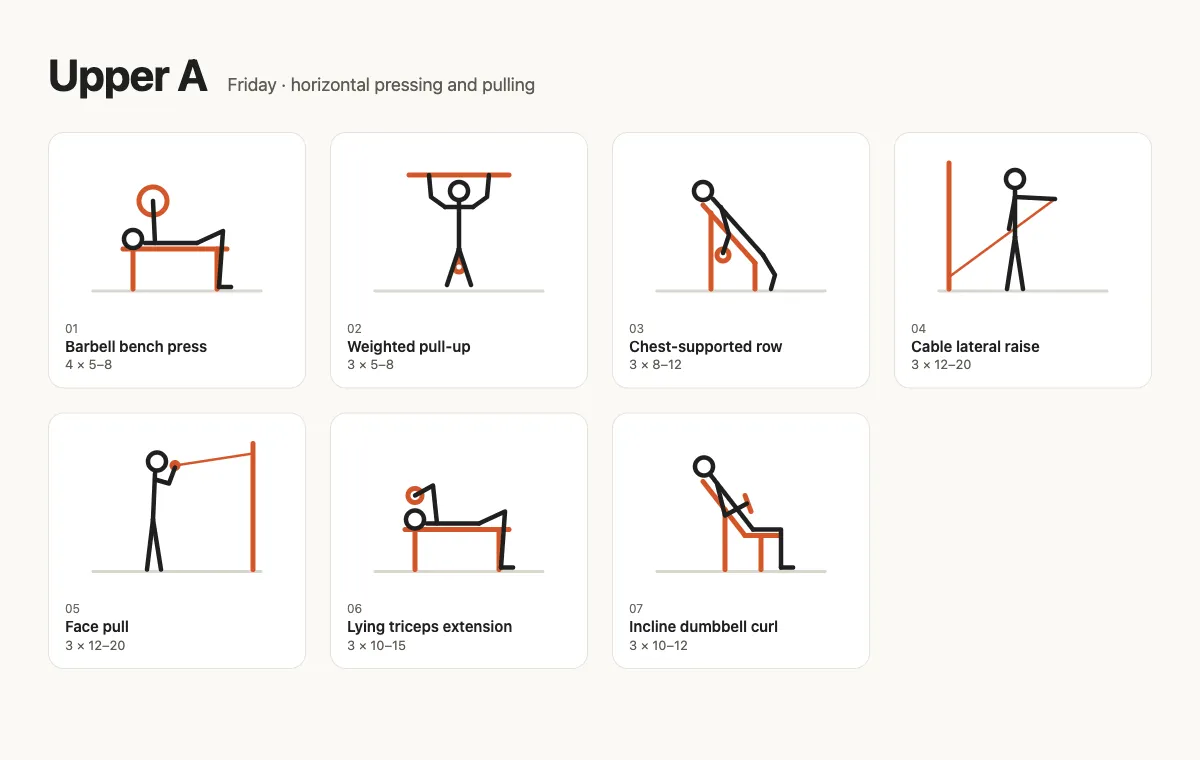
| # | Exercise | Sets x reps | RIR | Rest | Notes |
|---|---|---|---|---|---|
| 1 | Barbell bench press | 4 x 5-8 | 1-2 | 2-3 min | Grip no wider than ~1.5x biacromial width, shoulder blades retracted |
| 2 | Weighted pull-up, neutral grip | 3 x 5-8 | 1-2 | 2-3 min | Stop above any painful hang position |
| 3 | Chest-supported row | 3 x 8-12 | 0-1 | 2 min | Barbell row is an alternative if your back tolerates it |
| 4 | Cable lateral raise (A1) | 3 x 12-20 | 0-1 | 60-90 s | Raise slightly in front of the body (scapular plane) |
| 5 | Face pull or reverse pec deck (A2) | 3 x 12-20 | 0-1 | 60-90 s | |
| 6 | Lying or incline triceps extension, arms angled back (B1) | 3 x 10-15 | 0-1 | 60-90 s | Long-head emphasis without forcing a full overhead position |
| 7 | Incline dumbbell curl (B2) | 3 x 10-12 | 0-1 | 60-90 s |
Lower A (Saturday): quads and hamstrings
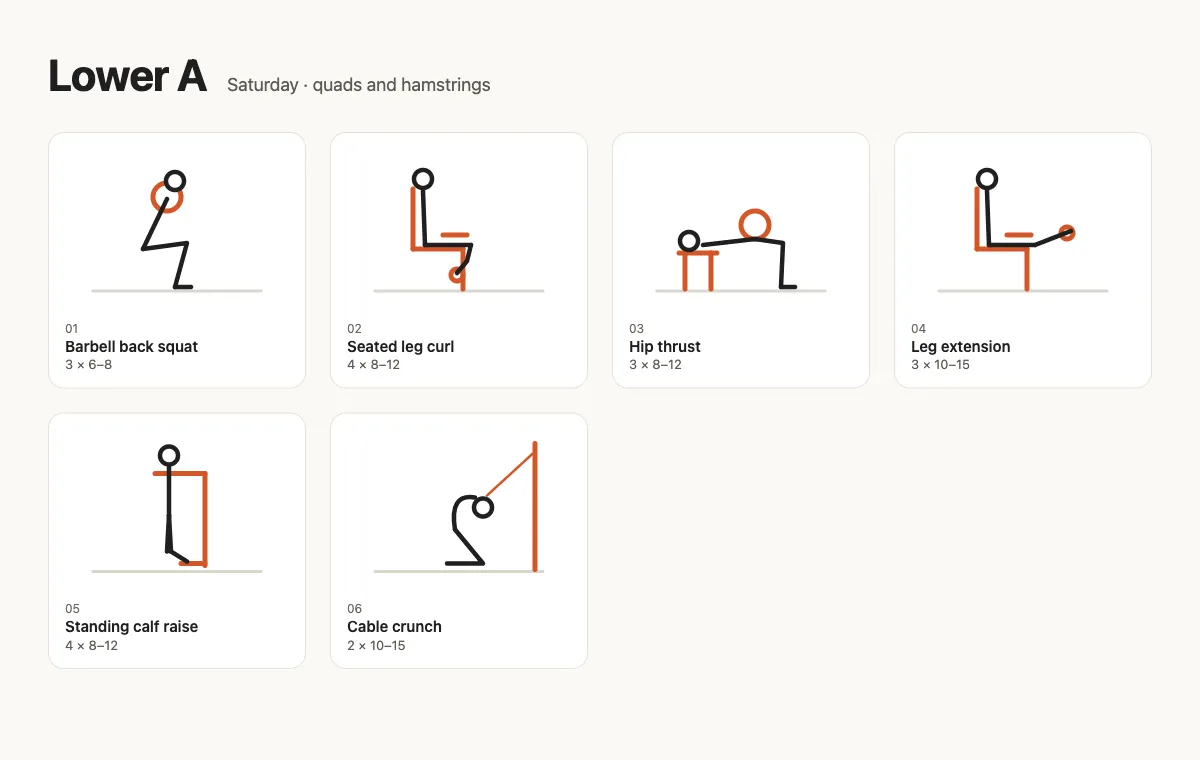
| # | Exercise | Sets x reps | RIR | Rest | Notes |
|---|---|---|---|---|---|
| 1 | Barbell back squat | 3 x 6-8 | 1-2 | 2-3 min | Hack squat or safety-bar squat if hips or back object |
| 2 | Seated leg curl | 4 x 8-12 | 0-1 | 1-2 min | Lean slightly forward to keep hips flexed |
| 3 | Hip thrust (barbell or machine) | 3 x 8-12 | 1 | 2 min | Pause 1 s at the top, ribs down |
| 4 | Leg extension | 3 x 10-15 | 0-1 | 1-2 min | |
| 5 | Standing calf raise | 4 x 8-12 | 0-1 | 1-2 min | Pause 2 s in the stretch |
| 6 | Cable crunch | 2 x 10-15 | 1 | 1 min |
Upper B (Monday): vertical and incline pressing, back width
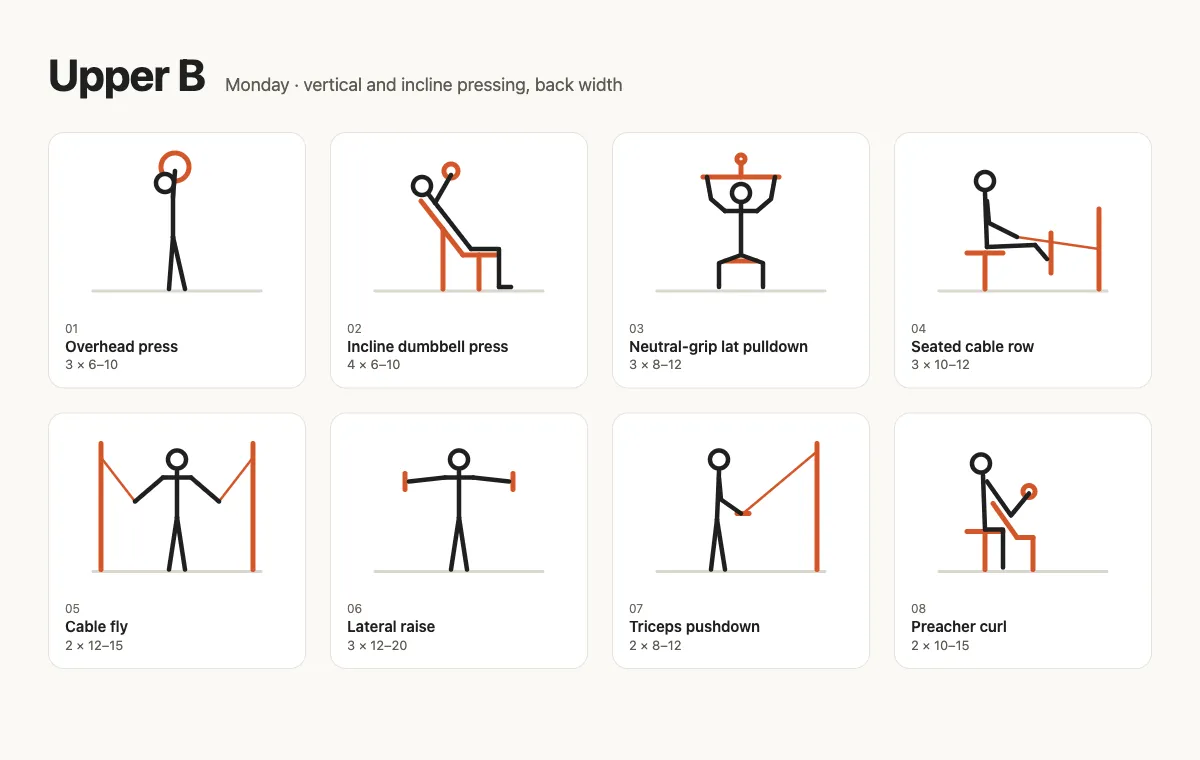
| # | Exercise | Sets x reps | RIR | Rest | Notes |
|---|---|---|---|---|---|
| 1 | Overhead press (standing barbell or seated dumbbell) | 3 x 6-10 | 1-2 | 2-3 min | Fallback: half-kneeling landmine press if overhead pressing is uncomfortable |
| 2 | Incline dumbbell press (~30°) | 4 x 6-10 | 1-2 | 2-3 min | Neutral or semi-neutral grip |
| 3 | Neutral-grip lat pulldown | 3 x 8-12 | 0-1 | 2 min | Full stretch at the top, no behind-the-neck pulls |
| 4 | Seated cable row | 3 x 10-12 | 0-1 | 2 min | |
| 5 | Pec deck or cable fly | 2 x 12-15 | 0-1 | 90 s | Stop before any anterior shoulder discomfort |
| 6 | Machine or dumbbell lateral raise | 3 x 12-20 | 0-1 | 60-90 s | |
| 7 | Triceps pushdown (A1) | 2 x 8-12 | 0-1 | 60-90 s | |
| 8 | Preacher or cable curl (A2) | 2 x 10-15 | 0-1 | 60-90 s |
Lower B (Tuesday): posterior chain and quads
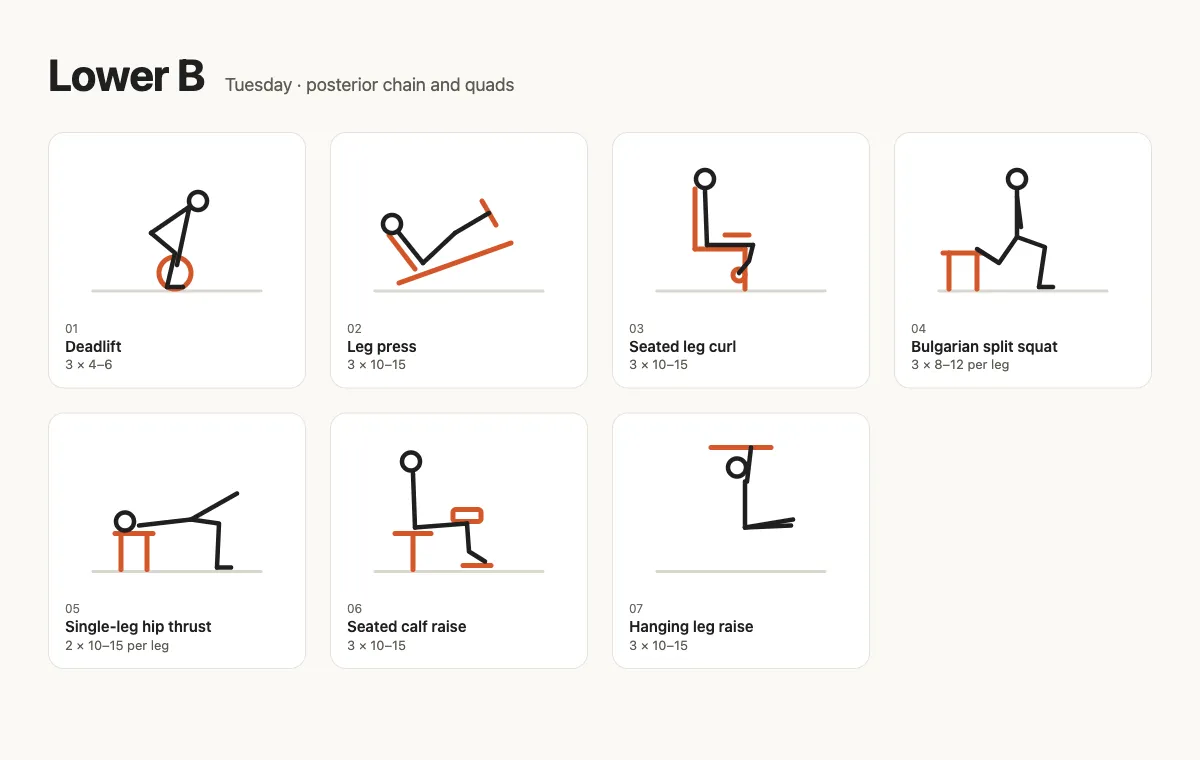
| # | Exercise | Sets x reps | RIR | Rest | Notes |
|---|---|---|---|---|---|
| 1 | Deadlift (conventional or trap bar) | 3 x 4-6 | 2-3 | 3 min | One heavy hinge a week; no grinding reps |
| 2 | Leg press or hack squat | 3 x 10-15 | 0-1 | 2 min | |
| 3 | Seated leg curl | 3 x 10-15 | 0-1 | 1-2 min | |
| 4 | Bulgarian split squat or walking lunge | 3 x 8-12 per leg | 1 | 2 min | Lean the torso slightly forward to bias glutes |
| 5 | Single-leg hip thrust or glute bridge | 2 x 10-15 per leg | 1 | 90 s | Option: cable pull-through as an extra hip-hinge accessory |
| 6 | Seated calf raise | 3 x 10-15 | 0-1 | 1-2 min | |
| 7 | Hanging or lying leg raise | 3 x 10-15 | 1 | 1 min | Use arm straps if dead-hanging irritates the shoulders |
Weekly hard sets per muscle (direct sets; indirect work adds on top)
| Muscle | Direct sets / week |
|---|---|
| Chest | 10 |
| Back | 12 |
| Quadriceps | 12 |
| Hamstrings | 7 direct, plus deadlift |
| Glutes | 8 (hip thrust, split squat, single-leg hip thrust), plus squat and deadlift |
| Side delts | 6, plus overhead pressing |
| Rear delts | 3, plus rows |
| Biceps | 5, plus pulling (about 11 counting pulls at half a set) |
| Triceps | 5, plus pressing (about 10 counting presses at half a set) |
| Calves | 7 |
| Total sets | about 83 across 4 sessions (22 / 19 / 22 / 20) |
Progression over 12 weeks
Use double progression. Once you reach the top of the rep range on every set at the target RIR, add the smallest load jump next session, then rebuild reps from the bottom of the range. If performance drops across two sessions, or joint irritation persists, hold the load or drop a set instead of forcing progression.
| Weeks | Focus | Volume | Effort |
|---|---|---|---|
| 1-2 | Landing: calibrate loads, learn to judge RIR | Drop 1 set from each exercise | 2-3 RIR |
| 3-6 | Base block | As written (~10-12 sets per muscle) | Main lifts 1-2 RIR, isolation 0-1 |
| 7-9 | Build block | Add 1 set to 3-4 priority exercises (up to ~14-16 per muscle) | 0-2 RIR |
| 10 | Optional light week | Cut sets by ~40%, keep loads | 3-4 RIR |
| 11-12 | Consolidate and check | As written | 1-2 RIR; in week 12 do estimated rep-max checks at 1-2 RIR, not 1RM tests |
Take the week-10 light week only if at least two of these appear: reps falling for two sessions at the same load, a joint that hurts above 3/10 on a normal day, or a week with under 6 hours’ sleep. These triggers are practitioner judgment, not from a trial.
3. The principles behind the program, with evidence grades
Grades: Strong = several meta-analyses agree. Moderate = one good meta-analysis or consistent trials. Limited = small studies, models, preprints. Expert opinion = practitioner reasoning, no direct trial.
| Principle | Program choice | What the evidence says | Grade |
|---|---|---|---|
| Weekly volume | 10-14 hard sets per muscle per week, up to ~16 for priority muscles in weeks 7-9 | Hypertrophy rises with weekly sets, with diminishing returns. Schoenfeld 2017 found a graded dose-response; the 2026 meta-regression by Pelland et al. fitted a curve with tapering returns. In adults over 60, Radaelli 2025 found low volumes already improve lean mass and size, while higher volumes mainly helped strength. | Strong (young adults); Moderate (50+) |
| Volume per session | About 10 hard sets or fewer per muscle per session | A preprint by Remmert et al. estimated the benefit flattens near ~11 fractional sets per session. Not peer-reviewed. | Limited |
| Frequency | Each muscle 2x per week | At equal weekly volume, higher and lower frequencies grow muscle similarly (Schoenfeld 2019, 25 studies). Pelland et al. also found the frequency effect compatible with negligible. | Strong |
| Proximity to failure | Most sets 0-2 RIR; heavy compounds 1-3 RIR | Robinson 2024: hypertrophy improved as sets ended closer to failure, but the analysis is exploratory and RIR was estimated. A trial in trained lifters found similar growth training to failure or with reps in reserve (Refalo 2024, summary). | Moderate |
| Load and reps | 4-8 reps on main lifts, 8-15 on accessories, 15-20 on joint-sensitive moves | For sets taken to failure, hypertrophy looks load-independent while strength is higher with heavier loads (Lopez 2021). | Strong |
| Rest between sets | 2-3 min compounds, 1-2 min isolation | Effects overlap across rest lengths, with central estimates for arm and thigh slightly favoring longer rests (Singer 2024). Supersetting antagonist pairs is a time-saving choice with no trial behind it. | Moderate (rest); Expert opinion (supersets) |
| Muscle length | Favor exercises that load the muscle stretched | Partials at long muscle lengths grew muscle at least as well as full range (Wolf 2023); a 2026 systematic review suggests longer-length training may give greater growth. A preprint meta-analysis on regional hypertrophy found no clear advantage. Mostly short trials in young, untrained people. | Moderate to Limited |
| Hamstrings | Seated leg curl twice a week | Seated training grew the whole hamstring group more than prone (+14% vs +9% volume over 12 weeks) in Maeo 2021, 20 healthy untrained adults. | Moderate |
| Glutes | Hip thrust plus split squat and single-leg bridge | Hip thrusts and squats grew glutes similarly when sets were matched in untrained students (Plotkin 2023). Split squats and single-leg variations as glute options are a practitioner addition. | Limited |
| Long-head triceps | Elbow extension with arms angled back, not forced overhead | Overhead-position extensions produced larger triceps gains than pushdowns in 21 untrained adults (Maeo 2022). Angling the arms back instead of fully overhead is a practitioner adaptation for shoulder comfort. | Limited |
| Bench press and shoulder load | Grip about 1.5x biacromial width or narrower, scapulae retracted | A modelling study of 10 strength athletes found narrower grips reduced acromioclavicular compression and scapular retraction reduced rotator-cuff and glenohumeral shear loads (Front Physiol 2024). | Limited |
| Overhead pressing and pulling | Overhead press kept as tolerated, landmine as fallback; neutral-grip pull-ups and pulldowns | Practitioner reasoning. No trial found showing better outcomes for either choice. | Expert opinion |
| Deloads | Optional light week 10, triggered by fatigue flags | A full week off mid-program did not change hypertrophy and slightly lowered some strength outcomes in trained lifters (Coleman 2024). A Delphi consensus sets out design principles but is opinion, not trial data. | Limited |
| Resistance training in older adults | Hard, progressive training, 2+ sessions per week | The NSCA position statement concludes resistance training is a powerful way to counter age-related loss of muscle strength and mass. | Strong |
| Cardio alongside lifting | 2 easy Zone 2 sessions of 30-40 min | Adding aerobic training did not compromise muscle growth or maximal strength; explosive-strength gains were blunted mainly when done in the same session (Schumann 2022). | Strong (whole muscle); Limited (fiber level) |
| Warm-up | 5 min easy cardio plus 2-4 ramp-up sets | Standard practice; no trial evidence was reviewed for it here. | Expert opinion |
Cautions
- Most trials were in young or untrained people, so applying them to experienced or older lifters is an extrapolation.
- Volume studies count indirect work (rows for biceps, presses for triceps) as half a set, so the table above counts it that way.
- Nutrition, sleep and tracking are not covered here. Gaining muscle without fat depends on them as well as on training.
- This is general information, not medical advice. Check blood pressure and cardiovascular health with a doctor before a hard training block, and see a physiotherapist if shoulder pain appears.